Water Baptism
Where Does Wellspring's Doctrine of Baptism Come From?
-
A Different Doctrine of Baptism: While historic Protestant churches view baptism as an ordinance following faith, Wellspring teaches that water baptism is essential to being born again and entering the kingdom of God.
-
A Different Theological Stream: Wellspring self-identifies as Trinitarian and Protestant, but its baptismal-regeneration theology aligns with Oneness Pentecostalism rather than with historic evangelical Protestantism.
-
An Existing Interpretation, Not a New Discovery: Norman James inherited from Bethesda a theology linking Jesus-Name baptism with remission of sins, circumcision of the heart, and being born again.
1. Water Baptism and Wellspring’s Doctrine of Being Born Again
Few doctrines in the history of the Christian church have generated as much discussion and disagreement as water baptism. Christians have debated its proper mode, its proper recipients, its relationship to faith, and what takes place spiritually when a person is baptized.
Because of these longstanding disagreements, this page is not intended to settle every historical debate concerning water baptism. Rather, its purpose is much narrower: to explain what Wellspring Church teaches about water baptism, to identify the historical tradition from which those teachings arise, and to compare them with the broader stream of historic Protestant Christianity from which Wellspring has long claimed to descend.
Understanding Wellspring’s doctrine of baptism is essential because it is inseparably connected to the church’s understanding of being born again and entering the kingdom of God.
Wellspring’s Understanding of Water Baptism
At Wellspring, water baptism is not viewed merely as a public testimony of faith or an act of obedience following conversion. Rather, it is presented as the means by which the believer receives the circumcision of the heart and remission of sins, making baptism an essential component of being born again and entering the kingdom of God.
Drawing upon the teaching of Norman James, converts are instructed that they must be baptized “in Jesus’ name for the circumcision of heart and remission of sin.” This wording is not simply a preferred expression or liturgical tradition. It summarizes Wellspring’s understanding of what God accomplishes through water baptism itself.
Because of this understanding, Wellspring ordinarily requires re-baptism for those baptized in other churches before they are recognized as having been born again and admitted into membership. The issue, therefore, is not merely the use of the name of Jesus, but the belief that baptism must be performed according to a specific theological understanding in order for particular spiritual effects to occur.
Why Wellspring’s Use of the Term “Ordinance” Can Be Misleading
Wellspring leaders have historically described water baptism as an “ordinance.” Yet the use of that term can obscure an important theological distinction.
Within much of evangelical Protestantism, the term ordinarily refers to an act commanded by Christ that follows conversion and bears witness to a spiritual reality already received. Baptism is therefore treated as an act of obedience and confession, not as the act through which the believer is born again, receives the remission of sins, or experiences an inward circumcision of the heart.
Wellspring assigns water baptism a substantially different function. According to its teaching, the believer receives the circumcision of the heart and remission of sins through water baptism itself, and that baptism forms an essential part of becoming born again and entering the kingdom of God. Calling the practice an “ordinance” therefore does not make Wellspring’s doctrine equivalent to the understanding ordinarily associated with that term in evangelical Protestantism.
2. A Different Historical Stream
Norman James's baptismal teaching did not develop in isolation. Its major theological elements had precedents within the Pentecostal world that shaped his ministry, particularly in the teaching of Bethesda Missionary Temple.
Bethesda authors Patricia Beall Gruits and James Lee Beall connected water baptism with the divine name, remission of sins, circumcision of the heart, and being born again. Gruits also connected the authority to administer baptism with possessing the correct revelation of the divine name. These teachings formed much of the theological framework that Norman James inherited and later developed further at Wellspring.
Although Beall rejected the term “baptismal regeneration” (Laying the Foundation, p. 186), he nevertheless taught that water baptism, when joined with repentance and faith, is instrumental in being born again (pp. 151, 190-192). His objection was not to baptism having a necessary role in being born again, but to the idea that the water itself produces grace or salvation apart from faith (p. 187).
Beall’s definition of “baptismal regeneration” differs from the way the term is often used in evangelical Protestant theology, where the term refers to any doctrine in which water baptism functions as a means or instrument of being born again, even when the believer is baptized in faith in Christ.
Wellspring's doctrine therefore does not arise simply as an unusual variation within Protestant teaching on baptism. It emerged from a different Pentecostal theological stream that, despite Bethesda's Trinitarian self-identification, converged with Oneness Pentecostal theology in the 1950s by making water baptism not merely an outward ordinance following conversion, but an essential component of the spiritual change associated with being born again.
Notably, the current Bethesda Christian Church describes baptism as a “sacrament” rather than merely an ordinance. That terminology more accurately reflects the function baptism was assigned in the theology Wellspring inherited from Bethesda: not simply an outward testimony to a saving work already received, but a divinely appointed means through which remission of sins, circumcision of the heart, and being born again were connected to the believer. Bethesda’s current statement of faith explicitly lists baptism among the church’s sacraments.
"Born of Water and the Spirit"
No passage has shaped Wellspring Church's doctrine of the kingdom more than Jesus' conversation with Nicodemus in John 3 - "Unless one is born of water and the Spirit, he cannot enter the kingdom of God." (John 3:5)
Throughout the nearly two-thousand-year history of the Christian church, few verses have generated more discussion than these words.
Nearly every major Christian tradition has appealed to John 3:5 when explaining the relationship between baptism, being born again, and the kingdom of God. The disagreement has never centered on whether Jesus' words are important. Rather, Christians have differed over what Jesus meant by "water," how this new birth occurs, and the role water baptism plays in entering the kingdom of God.
Because Wellspring repeatedly appeals to John 3:5 as the foundation of its doctrine of being born again, understanding the historical interpretation of this passage provides important context for evaluating the church's teaching.
The Historic Roman Catholic and Eastern Orthodox Understanding
Historically, both the Roman Catholic and Eastern Orthodox churches have understood John 3:5 as referring to sacramental baptism.
Within these traditions, baptism is ordinarily regarded as the means through which God grants being born again, remission of sins, and entrance into the covenant community. Baptism is not viewed merely as a public profession of faith but as a sacrament through which God truly works.
Although Roman Catholics and Eastern Orthodox Christians differ from one another in various aspects of sacramental theology, both have historically interpreted "born of water and the Spirit" as referring to Christian baptism administered within the life of the Church.
Importantly, however, neither tradition requires baptism to be performed exclusively "in Jesus' name." Both baptize according to Christ's command in Matthew 28:19: "...baptizing them in the name of the Father and of the Son and of the Holy Spirit."
The Historic Protestant Understanding
The Protestant Reformation challenged many aspects of medieval sacramental theology, including the relationship between baptism and spiritual regeneration (being born again).
Although Protestants have never been completely united on water baptism, they have generally maintained that regeneration is ultimately the work of the Holy Spirit received through faith in Jesus Christ.
Many Protestant interpreters understand the "water" of John 3:5 in one of several ways:
-
as a reference to Christian baptism that accompanies faith but does not itself regenerate;
-
as a symbolic reference to the cleansing work of the Holy Spirit promised in passages such as Ezekiel 36:25–27;
-
or as a metaphor for spiritual cleansing rather than the physical act of water baptism itself.
Regardless of these interpretive differences, the historic Protestant stream has generally rejected the conclusion that John 3:5 establishes water baptism as the act that itself results in being born again.
Consequently, Baptist, Reformed, Presbyterian, Wesleyan, Evangelical Free, Christian and Missionary Alliance, Assemblies of God, and many other Protestant churches have historically proclaimed salvation and being born again through faith in Christ while rejecting the view that baptism performed according to a prescribed formula is itself the moment of being born again.
The Oneness Pentecostal Understanding
The doctrine taught within Oneness Pentecostalism differs significantly from historic Protestant theology.
Oneness churches commonly interpret John 3:5 as the following:
-
"born of water" referring to water baptism,
-
"born of the Spirit" referring to baptism of the Holy Spirit with the evidence of tongues,
-
together these experiences constitute being born again.
This understanding closely parallels Wellspring's doctrine of being born again.
Oneness Pentecostal theology understands Acts 2:38 as explaining Jesus' teaching in John 3:5. Peter's instruction to repent, be baptized in Jesus' name, and receive the Holy Spirit is understood as describing how a person enters the kingdom of God. Oneness Pentecostal theology also commonly teaches that God grants the remission of sins through water baptism and associates baptism with the "circumcision of Christ" described in Colossians 2:11-12.
Norman James did not originate these theological concepts. The same underlying framework was already present at Bethesda Missionary Temple. Patricia Beall Gruits connected water baptism with being born again, remission of sins, and circumcision of heart, while also teaching the divine-name reasoning by which baptism in the Lord Jesus Christ was understood to fulfill Matthew 28:19.
James Lee Beall later articulated the relationship between the divine name, Jesus-Name baptism, circumcision of heart, and Christian initiation even more explicitly. Norman James inherited this framework through Bethesda and subsequently carried it into Wellspring.
Norman James gave that inherited theology a distinctive and unusually explicit required baptismal formula by requiring converts to be baptized “in Jesus’ name for the circumcision of heart and remission of sin.” Neither the Bethesda nor mainstream Oneness Pentecostal teaching require this exact formula, although both connect water baptism with remission of sins and spiritual circumcision.
Rather than introducing an entirely new doctrine, James’s formula gave explicit verbal expression to theological concepts already present in the tradition he inherited through Bethesda.
3. Inheritance from Bethesda
Being Born Again, Jesus-Name Baptism, and the Circumcision of the Heart
The following statement appears on Wellspring Church's website:
Several important theological assumptions are embedded within this short paragraph. Because these assumptions are so familiar within Wellspring, many members may not immediately recognize them as interpretations of the biblical text rather than the wording of Scripture itself.
First, the parenthetical explanations - "(baptism in water)" and "(baptism of the Holy Spirit)" - do not appear in John 3:5 itself. They represent Wellspring's interpretation of Jesus' words rather than the wording of the biblical text. While this interpretation has long existed within Oneness Pentecostalism, it is not the historic Protestant understanding of John 3:5.
Second, the statement describes "the process of becoming born again." Jesus certainly taught that a person "must be born again" (John 3:3–8), but He did not describe being born again as a three-step process. The language of "the process of becoming born again" represents a theological conclusion drawn from a particular interpretation of Jesus' words, rather than the wording of Jesus Himself.
Finally, by interpreting "born of water" as water baptism and "born of the Spirit" as Spirit baptism, Wellspring adopts the same interpretive framework that has historically characterized Oneness Pentecostal theology. Norman James did not introduce a previously unknown interpretation of these passages; he inherited an existing framework from Bethesda and later developed it within Wellspring, including his distinctive baptismal wording.
In this way, John 3:5 becomes much more than an isolated proof text. It becomes the interpretive lens through which Wellspring understands Acts 2:38, Acts 19, Colossians 2, and the entire doctrine of regeneration.
Why Wellspring Requires Jesus-Name Baptism
One question naturally arises from Wellspring's insistence upon baptism "in Jesus' name." If Jesus commanded His disciples to baptize "in the name of the Father and of the Son and of the Holy Spirit" (Matthew 28:19), why does Wellspring require a different baptismal wording?
An appeal to Christ’s authority does not, by itself, explain Wellspring’s requirement. Trinitarian Christians also understand baptism “in Jesus’ name” as baptism performed under the authority of Jesus Christ while still regarding baptism in the name of the Father, Son, and Holy Spirit as fully valid. Something more is therefore required to make Trinitarian baptism deficient.
Wellspring inherited from Bethesda the same divine-name logic that is foundational to Oneness Pentecostalism: the singular “name” of Matthew 28:19 is understood to be Jesus, and the baptismal accounts in Acts are therefore treated as establishing the wording required for Christian baptism.
The divine-name doctrine is therefore the load-bearing claim in Wellspring’s argument against Trinitarian baptism. It is the theological step that transforms the references to baptism “in Jesus’ name” in Acts from descriptions of baptism performed under Christ’s authority into a required spoken formula. Without the additional claim that “Jesus” is the singular divine name of the Father, Son, and Holy Spirit and must therefore be verbally invoked in baptism, the appeal to Acts does not by itself establish that baptism using the words of Matthew 28:19 is invalid.
This is why the disagreement between Oneness and historic Trinitarian theology is foundational rather than merely verbal. Oneness theology identifies Jesus as the singular divine name of the Father, Son, and Holy Spirit. Historic Trinitarian Christianity does not. It confesses one God in three distinct persons - the Father, the Son, and the Holy Spirit - and therefore does not understand “Jesus” to be the personal name of all three. The baptismal disagreement rests on that deeper theological divide.
Norman James and Wellspring inherited this divine-name doctrine from Bethesda. Beginning in the 1950s, Patricia Gruits and later James Lee Beall moved Bethesda away from Myrtle Beall’s earlier, broader Trinitarian position and toward a theological framework that paralleled Oneness Pentecostalism. Although James Lee Beall explicitly denied being Oneness or “Jesus Only,” he nevertheless retained the foundational theological premise of the Oneness Pentecostal movement: that “Jesus” is the singular divine name of the Father, Son, and Holy Spirit (Beall, Rise to Newness of Life, p. 61; Beall, Laying the Foundation, p. 169).
Once that divine-name doctrine is accepted, the baptismal references in Acts are no longer understood merely as descriptions of baptism performed under Christ’s authority. They are instead treated as establishing the required spoken wording for Christian baptism, while the Trinitarian wording of Matthew 28:19 is understood as fulfilled by invoking the name of Jesus.
That distinction matters because, within the Oneness-Bethesda-Wellspring framework, the spoken formula of Jesus’ name is connected with more than Christ’s authority. It is also connected with the remission of sins and the circumcision of the heart. A Trinitarian baptism can therefore be regarded as insufficient not simply because different words were spoken, but because it is understood to lack the spiritual effect attributed to Jesus-Name baptism.
For further reading: Jason Young, “In Jesus’ Name: An Examination of the Oneness Pentecostal Baptismal Formula,” examines the Oneness argument that baptism “in Jesus’ name” requires the spoken formula of Jesus’ name and considers the biblical use of the phrase “in the name.”
Wellspring's Teaching on Circumcision of the Heart
This connection between Jesus-Name water baptism, circumcision of the heart, and being born again was taught by Patricia Gruits within the Bethesda theological tradition and was subsequently inherited by Wellspring. It represents a combination of biblical concepts rather than a causal sequence explicitly taught in Scripture by the New Testament apostles.
The biblical question is not whether circumcision of the heart is real. It plainly is. The question is whether Scripture teaches that this inward work of God is accomplished through water baptism, and specifically through speaking the name of Jesus during baptism.
The New Testament does not make that claim.
The Bible clearly teaches the reality of circumcision of the heart. The Old Testament speaks of the heart being circumcised (Deuteronomy 10:16; 30:6; Jeremiah 4:4), and Paul uses the expression explicitly in Romans 2:29. What Scripture does not teach, however, is that circumcision of the heart occurs in water baptism or is conferred through the administration of baptism by a human minister.
That distinction is especially important in Colossians 2:11–12. Paul was familiar with the expression “circumcision of the heart” and used it elsewhere (Romans 2:29), yet when discussing circumcision and baptism in Colossians he did not use that expression. Instead, he spoke of “the circumcision of Christ.” Paul does not say that water baptism is the means by which the heart is circumcised, nor does he state that the verbal invocation of Jesus’ name in baptism is what causes such a circumcision to occur.
Nor does the expression “circumcision of the heart” appear in any New Testament baptism account. The apostles never explain baptism by saying that a minister, through water baptism or the pronunciation of a particular baptismal formula, performs a circumcision of the believer’s heart.
The central problem is not that the individual biblical concepts are absent from Scripture. Circumcision of the heart is biblical. Water baptism is biblical. Baptism in the name of Jesus is biblical. The problem is that Scripture does not establish the causal sequence Bethesda and Wellspring construct between them: that the verbal invocation of Jesus’ name in water baptism produces the circumcision of the heart, and that this circumcision is what causes a person to be born again.
This matters because the Bethesda-Wellspring theological tradition places substantial weight on precisely that claim. If calling on the name of Jesus in water baptism is understood to bring about the remission of sins and the circumcision of the heart, and if that circumcision is then regarded as necessary to being born again, Jesus-Name baptism becomes more than a preferred form of Christian baptism. It becomes a necessary step in being born again.
When a Baptismal Formula Becomes a Requirement
A central issue with Oneness Pentecostal, Bethesda, and Wellspring teaching is not merely the use of Jesus’ name in baptism. It is the belief that baptism must be performed with a prescribed combination of words and theological understanding in order for specific spiritual realities to occur, including remission of sins and circumcision of the heart.
This problem is especially clear in Norman James’s required formula: "in Jesus’ Name for the circumcision of heart and the remission of sin". Even believers who had already been baptized in Jesus’ name were required to be rebaptized using Norman James’s prescribed baptismal formula in order to join the church. Once the effectiveness of baptism is made to depend upon a specific combination of words that the New Testament itself does not prescribe, there is no clear biblical principle limiting what additional phrases a later teacher might also declare necessary.
Even the New Testament references to baptism in Jesus’ name do not use one identical verbal formula. Acts variously speaks of baptism “in the name of Jesus Christ,” “in the name of the Lord Jesus,” and “in the name of the Lord.” This makes it difficult to argue that the apostles were establishing one precise sequence of words that had to be repeated verbatim for baptism to be effective.
By the same reasoning, a teacher could require an additional biblical phrase such as “buried with Christ in baptism” and then treat that wording as necessary for baptism to function as the gateway to being born again and entering the Kingdom of God. The problem is not that such language is unbiblical, but that Scripture does not make its verbal inclusion a condition of baptism’s validity or spiritual effect.
The issue, therefore, is not whether the individual words or concepts are biblical. It is whether Scripture gives a human teacher authority to combine biblical concepts into a prescribed baptismal formula and then make that formula necessary for the spiritual effectiveness of baptism, for being born again, and for entering the Kingdom of God.
4. Comparing the Traditions
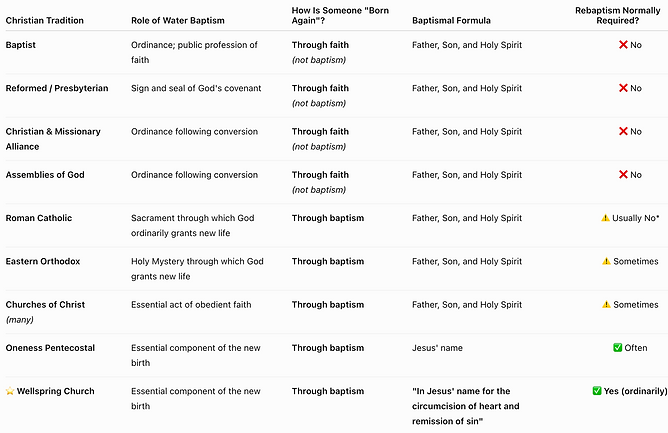
The debate over John 3:5 has continued for nearly two thousand years, but the major theological positions may be summarized as follows.
This comparison demonstrates that the central disagreement is not simply over the words spoken during baptism. The deeper issue concerns the doctrine of being born again.
Historic Protestantism has generally understood being born again as God's gracious work received through faith, with baptism serving as an ordinance - the sign and public confession of that saving work. Wellspring, however, stands within a different theological stream. Like Roman Catholicism, Eastern Orthodoxy, Churches of Christ, and Oneness Pentecostalism, it teaches that water baptism is essential to becoming born again, even though these traditions differ substantially regarding the role of the church, the doctrine of God, sacramental theology, and the proper baptismal formula.
Recognizing these distinctions helps explain why Wellspring's doctrine cannot be accurately described as simply another variation of Protestant baptism. While the church has long identified itself with the Protestant tradition, its understanding of being born again follows a theological pattern much more closely associated with sacramental and Oneness Pentecostal interpretations of John 3:5 than with the historic Protestant understanding of regeneration by faith.
5. Can Someone Be Saved but Not Born Again?
One of the most distinctive features of Wellspring's theology is its distinction between being saved and being born again. While many churches have believed in baptismal regeneration throughout history, Wellspring's theology is distinctive for combining baptismal regeneration with a sharp distinction between "being saved" and "being born again."
In most Christian traditions, these expressions describe different aspects of the same saving work of God. Whether Protestant, Roman Catholic, Eastern Orthodox, or Oneness Pentecostal, Christians have historically understood salvation and being born again to be inseparably connected. Although these traditions disagree about how spiritual regeneration occurs, they agree that to be saved is to be born again.
Wellspring teaches something different.
According to Norman James's teaching, a person may genuinely exercise faith in Christ and therefore be described as "saved" in one sense, while still not having been born again as required to enter the kingdom of God. This distinction rests largely upon Jesus' words to Nicodemus: "Unless one is born of water and the Spirit, he cannot enter the kingdom of God." (John 3:5)
At Wellspring, this passage is understood as describing three separate responses that together constitute being born again:
-
Repentance from sin.
-
Water baptism "in Jesus' name for the circumcision of heart and remission of sin."
-
Baptism of the Holy Spirit with the evidence of tongues.
Only after these responses has a person, in Wellspring's understanding, become born again and entered the kingdom of God. This distinction explains much of Wellspring's evangelism, its baptismal practice, and its view of Christian churches.
A believer from a Baptist, Presbyterian, Christian and Missionary Alliance, Methodist, or non-denominational church may be regarded as someone who loves Christ and has exercised genuine faith. Yet because that believer has not experienced the formula for being born again as Wellspring understands it, he or she is viewed as having fallen short of the kingdom described in John 3.
Likewise, someone previously baptized in another Christian church is ordinarily expected to receive baptism again using Wellspring's prescribed wording before being recognized as having been born again and admitted into the membership of the church.
This helps explain why Wellspring's doctrine of baptism cannot be viewed as a minor disagreement over wording or church practice. It reflects an entirely different understanding of what it means to become a Christian.
How This Differs from Historic Christianity
Throughout the history of the Christian church, theologians have debated whether baptism is a sacrament, an ordinance, a means of grace, or the ordinary instrument through which God grants regeneration. Those debates remain significant.
Yet across those disagreements, one point has remained remarkably consistent: the new birth is understood to be God's saving work.
Historic Protestantism teaches that being born again is the sovereign work of the Holy Spirit received through faith in Christ. Roman Catholic and Eastern Orthodox theology understand being born again as occurring through sacramental baptism. Oneness Pentecostal churches similarly identify being born again with repentance, baptism "in Jesus' name", and baptism of the Holy Spirit.
Despite these differences, all of these traditions generally speak of salvation and the new birth as describing the same divine work.
Wellspring's distinction is different.
Rather than asking only "How does a person become born again?", Wellspring first distinguishes being saved from being born again, and then teaches that entrance into the kingdom of God requires completing its prescribed three-step process.
This distinction is one of the defining characteristics of Norman James's theology. It explains why John 3:5 occupies such a central place within Wellspring's teaching and why water baptism carries a significance far beyond that found in most Protestant churches.
6. Summary
This page has not attempted to resolve every historical debate concerning water baptism. Christians have disagreed about water baptism for centuries, and thoughtful believers continue to interpret many of these passages differently.
The purpose of this page has been more modest: to identify where Wellspring's doctrine fits within the broader history of Christian theology.
The central question is not whether water baptism is important. Every major Christian tradition affirms that Christ commanded baptism. The question is what role baptism plays in being born again. Much of evangelical Protestantism has taught that regeneration is received through faith in Christ and has understood baptism as an ordinance or covenant sign rather than the instrument by which regeneration is effected. Roman Catholicism and Eastern Orthodoxy understand baptism sacramentally as the ordinary means by which God grants new life.
Like Roman Catholicism and Eastern Orthodoxy, Oneness Pentecostalism rejects the view that baptism is merely symbolic and teaches baptismal regeneration. It understands baptism "in Jesus' name" to be an essential component of being born again, commonly teaches that God grants the remission of sins through water baptism, and commonly associates baptism with the "circumcision of Christ" described in Colossians 2:11–12.
Wellspring likewise teaches that water baptism is essential to being born again, but its doctrine goes further by connecting the verbal invocation of Jesus' name in baptism with the remission of sins and the circumcision of the heart, and by treating that circumcision as necessary to being born again. Norman James formalized this theology in the prescribed baptismal wording, "in Jesus' name for the circumcision of heart and remission of sin," as part of Wellspring's doctrine of entering the Kingdom of God.
The central biblical problem is not that circumcision of the heart, water baptism, or calling on the name of the Lord are absent from Scripture. Each is biblical. The problem is that the New Testament does not establish the causal sequence the Bethesda-Wellspring tradition places between them: that the verbal invocation of Jesus' name in water baptism brings about the circumcision of heart and remission of sins, and that this circumcision is thereby necessary to being born again.
Seen in this historical context, Norman James did not introduce a previously unknown interpretation of Scripture. He inherited through Bethesda Missionary Temple a developed baptismal theology built upon the divine-name doctrine, Jesus-Name baptism, circumcision of the heart, and a particular understanding of being born again. That theology substantially converged with Oneness Pentecostalism, and James adapted it within Wellspring by imposing his own distinctive baptismal formula for entrance into the Kingdom of God.
Although Wellspring continues to identify itself as part of the Protestant tradition, its doctrine of water baptism - including its interpretation of John 3:5, its understanding of baptismal regeneration, its doctrine of circumcision of the heart in baptism, and its prescribed baptismal formula - aligns with Bethesda and Oneness Pentecostal theology rather than with historic Protestant Christianity.
Understanding these theological relationships does not by itself resolve every biblical question concerning water baptism. It does, however, place Wellspring's doctrine within its proper historical context, enabling readers to compare its teachings with the broader witness of the historic Christian Church and to evaluate those teachings in light of Scripture.