Latter Rain in Name, but not in Doctrine
A comparative analysis of Wellspring Church theology, Latter Rain teaching, and Oneness Pentecostal influence
I. Introduction
Wellspring Church claims a spiritual lineage from the Latter Rain revival and particularly from Myrtle Beall and Bethesda Missionary Temple in Detroit. They claim this lineage through the person and teachings of their founder, Norman H. James. This claim reinforces their authority and legitimacy. However, a comparison of their doctrinal system with primary Latter Rain and Bethesda sources reveals that Wellspring Church theology - especially their doctrine of being born again - does not reflect Latter Rain or Beall family teaching.
Instead, Wellspring Church distinctive understanding of being born again closely parallels Oneness Pentecostal doctrine, especially its interpretation of Acts 2:38 and the necessity of Jesus-name baptism. This paper argues that the doctrine of Norman James did not originate in Latter Rain teachings but was shaped by external Oneness Pentecostal influences prevalent during the 1950s–1970s.
II. Bethesda Missionary Temple Doctrine: Explicitly Non-Oneness
A. Myrtle D. Beall’s Book - The Plumb Line (1951)
In The Plumb Line, Myrtle Beall explicitly rejected Oneness theology, stating that Bethesda was not “Oneness” or “Jesus Only” (Beall, Plumb Line). She affirmed the classical Trinitarian doctrine of God. While she permitted both Matthew 28:19 and Jesus-name formulas as valid expressions of baptism, she denied that any specific formula was required for being born again.
B. Patricia Beall Gruits’ Book - Understanding God (1969)
Gruits’ widely used catechism is rigorously Trinitarian, structured around Father, Son, and Holy Spirit as distinct divine persons (Gruits, Understanding God). The text does not equate Acts 2:38 with being born again, does not require baptism in Jesus’ name, and does not teach the necessity of glossolalia for regeneration.
C. James Lee Beall’s Books - Laying the Foundation (1976) and Rise to Newness of Life (1977)
James (Lee) Beall, a major teacher at Bethesda, did teach Jesus-name baptism. However, he taught it within a Trinitarian framework (Beall, Rise to Newness of Life). He did not advocate:
-
Acts 2:38 as a formula for being born again,
-
modalistic or Oneness views of the Godhead
Therefore, although Norman James likely encountered Jesus-name baptism at Bethesda, the exclusive meaning he later assigned to being born again it is not part of Bethesda doctrine.
D. Bethesda Leaders’ Testimony
Bethesda leaders have stated that Norman James:
-
Took only a basic foundations class,
-
Held no leadership or teaching role,
-
Was never ordained, and
-
Later departed from the doctrine he was taught (Bethesda testimony).
Their testimony aligns with the doctrinal evidence and confirms he did not faithfully represent Bethesda theology.
III. Latter Rain Theology: Charismatic, Restorational, but Not Oneness
A. Core Features of Latter Rain Teaching
The Latter Rain revival emphasized:
-
Prophecy and laying on of hands
-
Fivefold ministry
-
Spiritual gifts
-
Unity within the body of Christ
Yet in all doctrinal statements, it remained classically Trinitarian.
B. Latter Rain’s Boundaries Against Oneness Theology
Richard Riss notes that Latter Rain networks did not accept Oneness doctrine and sometimes intentionally avoided association with Oneness groups (Riss, Latter Rain). Synan similarly affirms that the Latter Rain movement did not dispute the Trinity, and its controversy with the Assemblies of God never touched the doctrine of the Trinity or being born again (Synan, Holiness-Pentecostal Tradition).
C. No Latter Rain Teaching on Acts 2:38 on being born again
Latter Rain sources do not:
-
equate Acts 2:38 with John 3:5,
-
require Jesus-name baptism for being born again, or
-
require speaking in tongues as a component of regeneration.
These teachings belong uniquely to Oneness Pentecostalism, not to the Latter Rain revival.
IV. Norman James’ Doctrinal System: A Comparative Analysis
A. Norman’s “Three Steps for becoming born again”
Norman James taught that becoming born again consisted of:
-
Repentance
-
Baptism in Jesus’ name using the formula "for the circumcision of heart and the remission of sin”
-
Receiving the Holy Spirit with the evidence of tongues
(James, Christian Life Series)
This three-step sequence closely mirrors Oneness Pentecostal doctrine.
B. Acts 2:38 as the Formula for becoming born again
Norman James equated Acts 2:38 with John 3:5, presenting Acts 2:38 as the exclusive biblical pattern for becoming born again (James, Christian Life Series). This doctrine does not appear in Bethesda or Latter Rain sources.
C. Tongues Required for Completing the process of being born again
Norman James taught that speaking in tongues was required to complete the process for becoming born again - though not required to maintain salvation (James, Christian Life Series). This nuanced distinction is common in some Oneness-influenced independent groups but absent from the Bealls’ writings.
D. Norman James' Inconsistent Teaching on the Godhead
Norman James did not openly teach modalism. However, he:
-
referenced the Trinity in general teaching,
-
referred to Father/Son/Spirit as “names” or “titles” when defending mandatory Jesus-name baptism,
-
avoided doctrinal precision when pressed.
This inconsistency matches leaders influenced by Oneness theology while retaining some traditional charismatic language.
V. Oneness Pentecostal Sources as the Most Plausible Origin
A. The Oneness Literature Boom (1950s–1970s)
Norman James’s doctrinal system lines up almost identically with Oneness authors widely available during his formative ministry years:
-
John Paterson, The Real Truth About Baptism in Jesus’ Name (Paterson)
-
Frank Ewart, The Revelation of Jesus Christ (Ewart)
-
G.T. Haywood’s sermons (Haywood)
-
United Pentecostal Church International doctrinal pamphlets (UPCI)
These works teach:
-
Jesus-name baptism as required,
-
Acts 2:38 as the formula for becoming born again,
-
The necessity of tongues as evidence,
-
A diminished or modalistic Trinity.
B. Detroit as a Major PAW (Oneness) Center
Detroit was historically a major hub for the Pentecostal Assemblies of the World (PAW) - the oldest Oneness denomination in the United States (Tyson). Exposure to PAW preaching, street evangelism, and tract distribution would have been common.
C. Independent Pentecostal Blending
Many independent Pentecostal churches in the Midwest:
-
practiced charismatic gifts,
-
accepted Jesus-name baptism,
-
and adopted Oneness-style doctrine.
Norman James’s hybrid system fits this pattern.
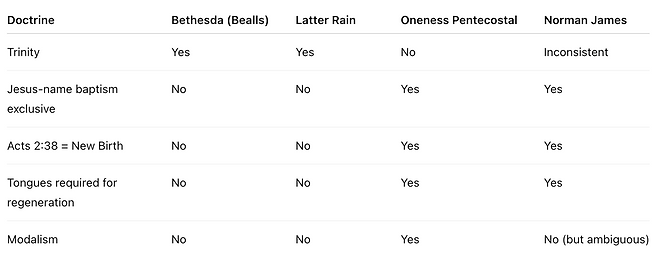
VI. Doctrinal Divergence Clearly Demonstrated
This comparison shows that Norman James’s system aligns with Oneness doctrine - not with the theology of Bethesda or the Latter Rain revival.
VII. Conclusion
The evidence demonstrates that Norman James’s doctrinal system did not originate with Myrtle Beall, James Lee Beall, Patricia Beall Gruits, or the Latter Rain movement. Bethesda’s theology was explicitly Trinitarian and rejected the very teachings that Norman James later embraced. Latter Rain theology was charismatic and restorational, but never Oneness or Acts 2:38–focused.
Norman James’s doctrine aligns instead with:
-
Acts 2:38 as the formula for becoming born again
These elements match the teachings of Oneness authors and denominations widely active in the Midwest during the mid-twentieth century.
Norman James's, and thus Wellspring Church's, theological construction is therefore best understood as a hybrid charismatic-Oneness synthesis created through external doctrinal borrowing, not as a continuation of Latter Rain or Bethesda teaching.
📚 Bibliography (Chicago Style)
Beall, Myrtle D. The Plumb Line. Detroit: Bethesda Missionary Temple, 1951.
Gruits, Patricia Beall. Understanding God. Grand Rapids: Zondervan, 1969.
Beall, James Lee. Laying the Foundations. Detroit: Bethesda Missionary Temple, 1976.
Beall, James Lee. Rise to Newness of Life. Detroit: Bethesda Missionary Temple, 1977.
Ewart, Frank J. The Revelation of Jesus Christ. Los Angeles: Ewart Publishing, 1927.
Haywood, G.T. Sermons and tracts. Indianapolis: Pentecostal Assemblies of the World.
James, Norman. Christian Life Series. Association of New Testament Ministries
Paterson, John. The Real Truth About Baptism in Jesus’ Name. St. Louis: Gospel Publishing House, 1950.
Pentecostal Assemblies of the World. Doctrinal Literature. Indianapolis: PAW Publishing.
Riss, Richard M. Latter Rain: The Latter Rain Movement of 1948. Montreal: Holy Light Publications, 1987.
Synan, Vinson. The Holiness-Pentecostal Tradition. Grand Rapids: Eerdmans, 1997.
Tyson, James. The Early Pentecostal Revival. Indianapolis: Voice and Vision, 1992.
United Pentecostal Church International. Doctrinal Papers and Pamphlets. Hazelwood, MO.